AI Vidia is a Denmark-based AI content production studio, and this is the operator playbook the AI Vidia team uses to build a brand-locked AI creative system that survives model updates and scales to 200 assets per month without brand drift. If you have run a Midjourney or Runway pilot in house and watched the 40th asset stop looking like the 1st, the problem is not the model. The problem is the absence of a written brand lock kit. A brand-locked AI creative system is a fixed set of inputs that constrains every render the same way every time, regardless of which underlying model is doing the work. AI Vidia ships at a 99.2 percent brand-safe pass rate across 70,342 images and 1,834 videos, and that number does not change when Sora, Veo, Runway, or Nano Banana ships a new version.
Why brand drift kills paid social
99.2%BRAND-SAFE PASS RATE
70,342IMAGES SHIPPED
48BRANDS LIVE
200ASSETS PER MONTH
Brand drift is what happens when the 40th render no longer matches the 1st. In a paid social account that ships 100 to 200 assets per month, drift compounds inside a single sprint. By week three the feed reads like five different brands speaking with five different voices, and the algorithm cannot find the variance signal it needs to pick winners.
One hero reference, one style card, one negative prompt library. The system before the system runs.
The cost is two-sided. On the brand side, drift forces a creative director to spend half a sprint vetoing assets that should have failed at render. On the performance side, drift halves the effective creative supply because assets that read off-brand cannot ship even if they perform. Meta for Business data shows campaigns with 5 or more on-brand variants produce 30 to 50 percent lower CPA than thin variant counts; drift puts an account back into the thin lane even when render volume is high.
The fix is a brand lock kit, not a model switch. A model switch resets the drift problem for two weeks and then reintroduces it. A brand lock kit constrains drift to under 1 percent per render and holds across model upgrades, vendor swaps, and team turnover.
Brand drift comparison: no system, basic prompt, full 4-asset kit
The most useful way to think about a brand-locked AI creative system is to compare drift rates across three setups. The AI Vidia team has run side-by-side measurements on 12 brands in flight at the time of writing, scoring each variant against a 12 point brand-safe rubric on logo integrity, color fidelity, prop placement, lighting continuity, and product silhouette. The pattern is consistent enough to publish.
Setup
No system
Basic prompt template
Full 4-asset brand lock kit
Brand-safe pass rate (first render)
34 percent
71 percent
99.2 percent
Renders per shipped variant
4 to 7
2 to 3
1.0 to 1.2
Drift after 50 renders
severe
moderate
negligible
Hours of art director review per 100 assets
12 to 18
5 to 8
1.5 to 2
Survives a model version bump
no
partial
yes
Cost per shipped asset (model plus review)
EUR 32 to 48
EUR 14 to 22
EUR 6 to 11
Time to launch a new SKU at brand-safe
10 to 14 days
4 to 7 days
48 hours
Same prompt, same model. Left: no kit. Right: 4-asset kit applied.
Read the row on cost per shipped asset. The unit cost gap is a system gap, not a model gap. The model is the same in all three setups; what changes is how many renders fail on first pass, and how much human review each render needs. The full brand lock kit pushes first-pass success above 99 percent, which is what makes the math work at 200 assets per month inside a sane retainer.
The other row to read is survives a model version bump. A basic prompt template is tuned to one model's quirks. When that model ships a new version, half the prompts stop working. The 4-asset kit encodes the brand at the specification level instead of the prompt level, so a model bump is a render queue rerun, not a rebuild.
The 4-Asset Brand Lock Kit
This is the strategic framework. Four artifacts. Each artifact constrains a different failure mode. Build all four before the first paid render goes out the door, or accept that drift is the price of skipping one.
Asset 1: hero reference image with surface, lighting, and angle spec. One photograph or rendered hero that pins the visual world. The reference must specify the exact surface (off-white linen, brushed brass, polished concrete), the lighting (soft north window at 70 degrees, hard rim from camera left), and the camera angle in degrees of elevation. Most brands shortcut this with a Pinterest board. A board is not a reference; a board is 40 references that contradict each other. One image, fully spec'd, beats forty.
Asset 2: style prompt card encoding palette, texture, and mood. A model-readable text card with the brand's three primary hex codes, one supporting color, the named texture vocabulary (matte ceramic, woven linen, cold-pressed paper), and a four-word mood descriptor. The card is appended to every render prompt verbatim. It is not a prompt template; it is a constraint that runs after the creative prompt and before the model.
Asset 3: negative prompt library listing prohibited elements. A list of every visual element that must not appear: competitor brand marks, off-palette colors, anatomically incorrect hands, plastic-textured products that should read as glass, generic stock-photo lighting, generic stock-photo plates. The library starts at 30 entries and grows by 5 to 10 per week as the team finds new failure patterns. The AI Vidia negative prompt library across 48 brands sits at over 400 entries.
Asset 4: 12-point brand-safe pass and fail checklist. The QA gate. A variant must hit 11 of 12 points to ship: logo integrity, color fidelity within Delta E 3, product silhouette accuracy, label legibility, hand and finger anatomy, reflection and lighting continuity with the hero reference, prop placement inside the brand world, background depth stability, motion cadence within 0.8 to 1.4 seconds between cuts (for video), sound mix peak under minus 3 dB (for video), first frame stopping power above a 30 percent internal panel threshold, and platform-specific disclosure compliance. The checklist takes a reviewer 45 to 60 seconds per asset after two weeks of reps.
Want a structured plan for your AI creative pipeline? 20-minute call, no pitch deck.
That contrarian framing matters because most procurement conversations open with which model do you use. The right opening question is which brand specification do you ship against. A brand without a written specification cannot have a brand-locked AI creative pipeline; it can only have a competent prompter who is one resignation away from leaving with the brand in their head.
The 48-Hour Brand System Build
This is the tactical framework. The 4-Asset Brand Lock Kit is what you build; the 48-Hour Brand System Build is how you build it. The AI Vidia team runs this exact two-day shape on every new Performance Retainer, and it has produced shippable systems for 48 brands across 14 countries.
Day 1 morning: reference image audit and style extraction. Pull the brand's last 12 months of paid social winners, hero photography, and packaging shots. Score each on consistency: lighting, color cast, composition, prop language. Extract the top 3 patterns that appear across 70 percent or more of the winners. These patterns become the candidate hero reference. Time: 3 to 4 hours with the brand team and one art director on call.
Day 1 afternoon: draft the style card and negative prompt library. Write the model-readable text card from the extracted patterns. Encode hex codes, texture vocabulary, mood descriptor. Build the first 30 entries of the negative prompt library by listing every off-brand pattern the audit surfaced. Run a smoke test of 6 renders against the candidate kit, no human cherry picking. Time: 3 to 4 hours.
Day 2 morning: run a 3-shot test batch. 30 renders across three scene archetypes that the brand will need every month: hero product shot, lifestyle shot, UGC-style frame. Score each render against the 12 point checklist. Below 90 percent pass, return to step 2 and tighten the negative prompt library. Above 90 percent, proceed. Time: 3 to 5 hours including review.
Day 2 afternoon: pass and fail gate, iterate to 99 percent brand-safe. Run a final 30 render batch with the locked kit. Score against the 12 point checklist with the brand or creative director in the room. If pass rate hits 99 percent, the kit is shipped to the production queue and the first 40 paid assets render that night. If not, identify the failing point, add to the negative prompt library, and rerun. The AI Vidia median number of iterations to hit 99 percent on day two is 1.4. Time: 3 to 4 hours.
Two days is a calendar promise, not a working-hours promise. The full 48 hours is 14 to 17 working hours from the AI Vidia side and 4 to 6 from the brand side. After that, the kit is locked and runs unchanged for 8 to 12 weeks before a planned refresh.
Proof: 99.2 percent brand-safe across 70,342 images
The 4-Asset Brand Lock Kit and the 48-Hour Build have produced consistent output across 48 brands in 14 countries. AI Vidia has shipped 1,834 AI videos and 70,342 AI images using this system. The brand-safe pass rate sits at 99.2 percent on first render after kit lock, which means roughly 1 in 125 renders requires a human-led tweak before ship. Across over EUR 2.4M in paid media spend optimized behind these assets, the system has produced 2.4x ROAS on winning cohorts and a 62 percent reduction in creative production cost on like-for-like baselines.
The brands that hit 99 percent brand-safe at scale are not the ones with the best prompts. They are the ones that wrote the brand down in a way the model can read.
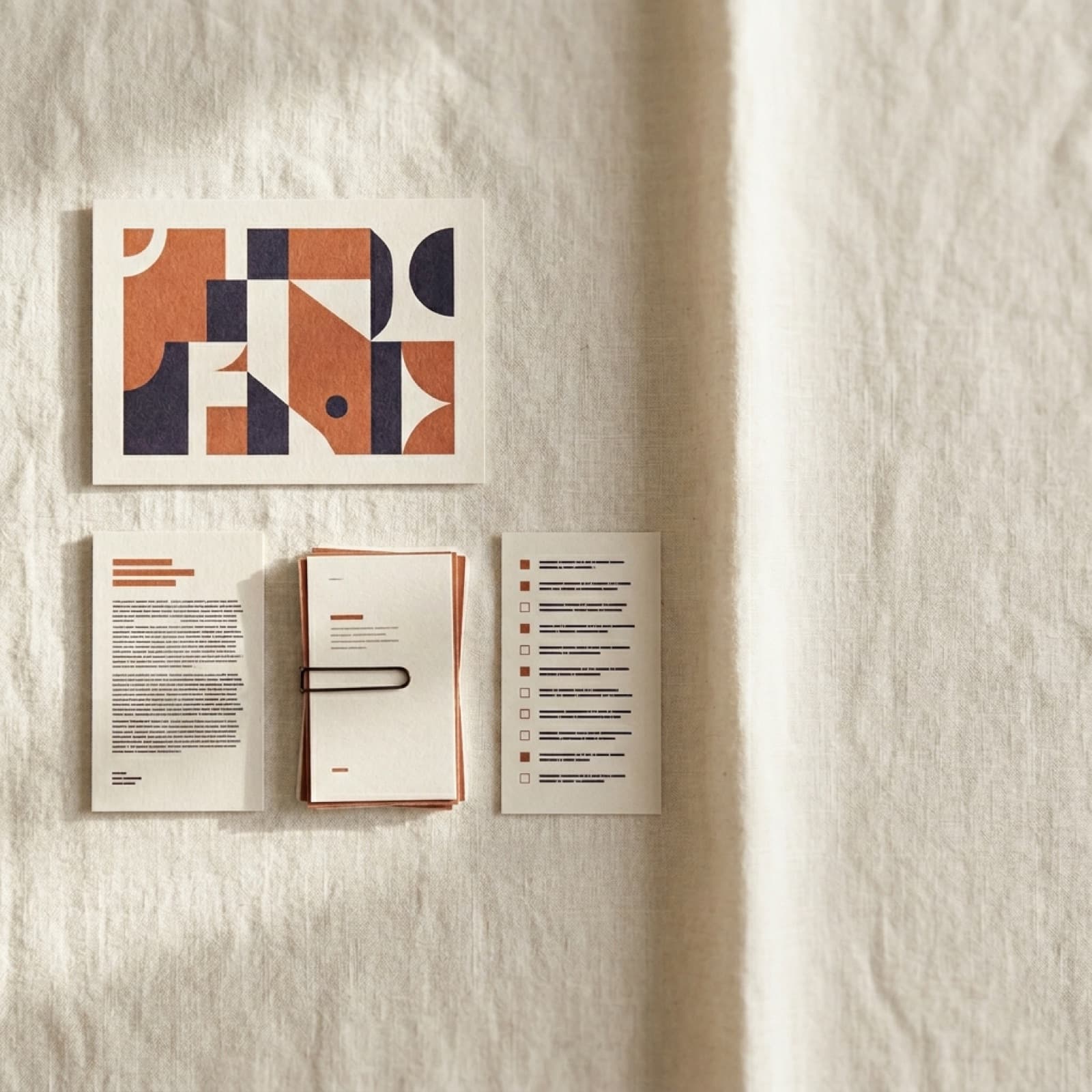
The 12 point checklist as a tactile artifact. Reviewers move 45 to 60 seconds per asset after two weeks of reps.
The live case is IndianBites, a DTC food brand that ran the kit for 11 weeks. 142 ads shipped, 12x weekly test volume, 62 percent lower production cost, 2.4x ROAS on winners. The kit held consistent across 50+ ads on product without a brand-safe failure. Read the full account at case-studies/indianbites, and see how this kit feeds the weekly cadence at insights/scale-ad-creative-100-variants-week.
When the system wins, and when to skip it
Run the 4-Asset Brand Lock Kit and the 48-Hour Build if your account ships 40 or more variants per month, paid social is a primary acquisition channel, and your in-house team has tried and failed to keep an AI pipeline brand-safe past the first sprint. Run it if Legal has started asking where assets came from and you need an audit trail. Run it if you are about to ship a new SKU or enter a new market and need 12 to 18 hero variants live in under a week.
Skip the system if total monthly creative volume is under 20 assets, paid spend is under EUR 15,000 per month, or the brand has no existing visual assets to extract a hero reference from. Below those thresholds, a competent in-house designer prompting Midjourney or Nano Banana on a casual cadence will outperform a 4-asset kit because the kit overhead is larger than the volume it serves. The kit pays back at 40 plus assets per month and compounds from there.
Skip it also if your team is not willing to write the negative prompt library down. The negative library is the most underrated of the four assets and the most likely to be skipped under deadline pressure. Without it, drift returns inside three weeks no matter how locked the hero reference and style card are.
Next step
If you want the AI Vidia team to build a brand-locked AI creative kit on your account in 48 hours, book a 30 minute Performance Retainer scoping call at book. The image-first surface with sample kits and pricing sits at ai-image-ads; the video-first surface at ai-video-ads. Read the founder's profile at about/kevin-dosanjh. AI Vidia ships the first paid asset inside 72 hours of kickoff and the first locked kit inside 48.
Frequently asked questions
01What is a brand-locked AI creative system, in plain terms?
It is a fixed set of four artifacts (a hero reference image, a style prompt card, a negative prompt library, and a 12 point pass and fail checklist) that constrains every AI render against the same brand specification. The artifacts run before and after the creative prompt, so the model sees the brand the same way on every render. Brand drift is held under 1 percent per asset and the system survives model upgrades because the brand is encoded at the specification level, not the prompt level. AI Vidia ships at a 99.2 percent brand-safe pass rate across 70,342 images using this exact setup.
02How long does it take to build a brand lock kit from scratch?
AI Vidia builds a complete kit in 48 hours of calendar time, broken into a Day 1 audit and draft step and a Day 2 test batch and pass and fail gate. The working-hours load is 14 to 17 hours from the AI Vidia side and 4 to 6 hours from the brand side. The kit is locked at the end of Day 2 once a 30 render batch hits 99 percent brand-safe. After that, the first 40 paid assets render the same night, and the kit runs unchanged for 8 to 12 weeks before a planned refresh.
03Does the system survive a model version upgrade like Sora 3 or Runway Gen-5?
Yes, because the brand is encoded at the specification level rather than the prompt level. The hero reference image, the style prompt card, and the negative prompt library all describe the brand in model-agnostic terms (hex codes, texture vocabulary, prohibited elements), so any model that takes a text card plus a reference image can render against the kit. When a new version ships, the AI Vidia team runs a 30 render smoke test in the new model and adjusts only the negative prompt library if a new failure pattern appears. Median migration time across model upgrades has been under 4 working hours per brand.
04What size of brand actually needs the full 4-asset kit?
The kit pays back at 40 or more variants per month and compounds from there; below 20 variants per month it is overbuilt. The other thresholds are paid social being a primary acquisition channel, monthly spend above EUR 15,000, and an existing library of brand assets the team can audit to extract a hero reference. Brands that meet all four conditions see the full 99.2 percent pass rate and the 62 percent production cost reduction; brands that meet two or fewer should run a lighter prompt template instead. The AI Vidia team turns down kit builds when the volume math does not justify the overhead.
05Can an in-house team build the kit themselves, or does it require an agency?
An in-house team can build a workable kit if it has a senior art director, a performance lead, and a half-time prompt engineer for two days. The hard parts are writing the negative prompt library exhaustively (most teams stop at 8 to 12 entries when the library needs 30 plus to start) and running a strict 12 point pass and fail checklist with no exceptions for sentiment. AI Vidia accelerates the build because the team has 400 plus negative prompt entries already cataloged across 48 brands and reuses them as a starting library. In-house builds typically take 5 to 10 days for a first kit; the agency build runs in 48 hours.
Next step
Get your first 12 on-brand AI variants in 14 days.
Book a 20-minute strategy call with the AI Vidia team. No pitch deck, just a structured plan for your creative output.